The Man Who Defies Common Sense and Opens New Frontiers
Jin Mayama, Novelist
"First, please discard any basic knowledge you have, such as the idea that quantum computers are just good at prime factorization or secret spy communications."
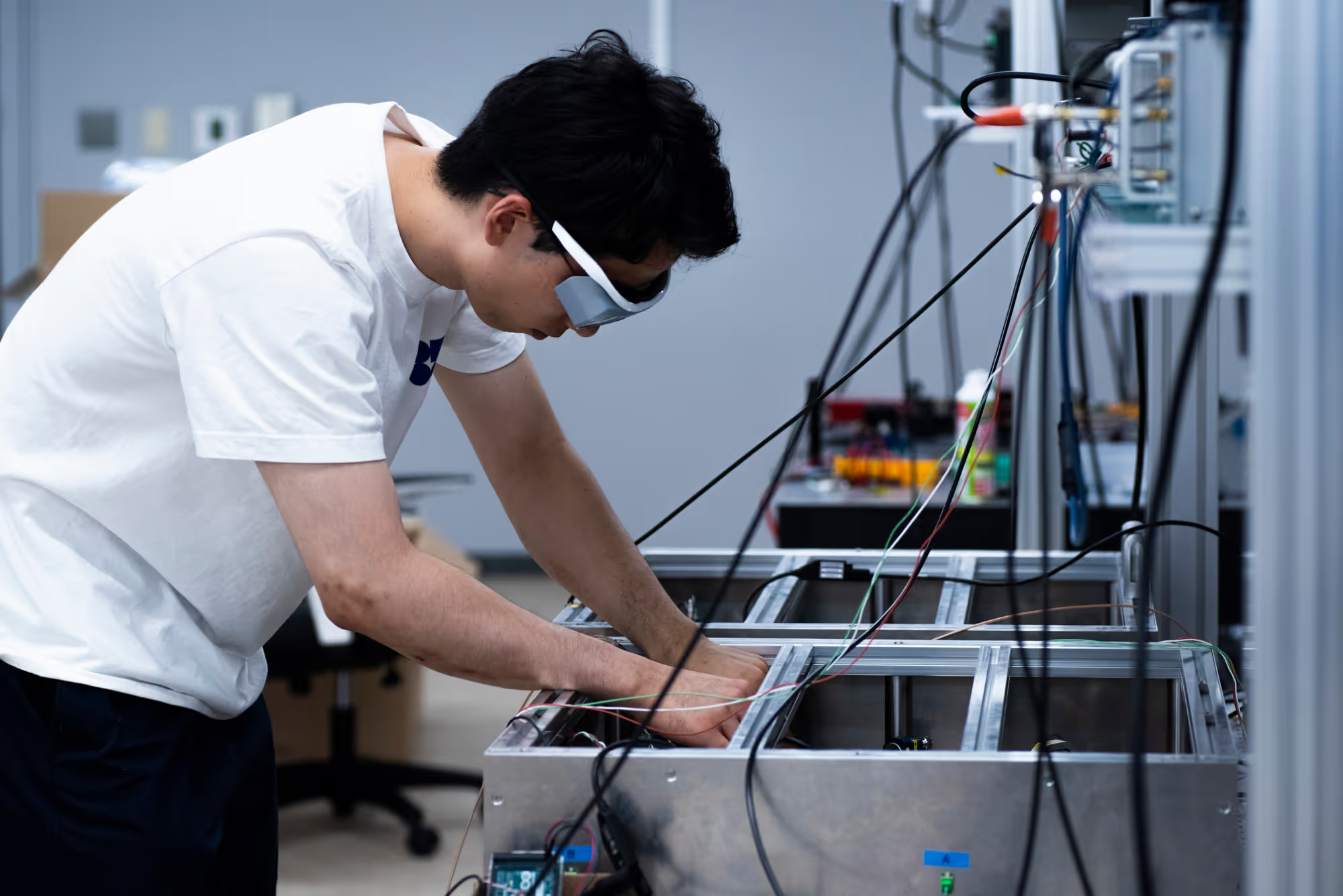
These are the words I remember so clearly from January 2020, when I first met Professor Akira Furusawa in his laboratory at the University of Tokyo’s Faculty of Engineering.
To be honest, I am terrible at science. Physics, in particular, was a subject I completely abandoned back in high school. Despite this, I have written works centered on the cutting edge of technology, including nuclear power and space exploration. Each time, I start from the basics, identifying exactly where my understanding ends. I visit experts, shamelessly expose my ignorance, and beg for support to eventually transform that knowledge into a novel.
I never imagined that a little preparation would make these subjects easy to grasp. My mindset has always been that a story can be written even without full technical understanding, encouraging myself with the thought that my readers are at the same level as I am. However, that day, I knocked on the laboratory door feeling a heavy sense of regret and anxiety, wondering why I had chosen such a difficult genre.
Then, the very first thing Professor Furusawa said to me was that opening line.
Wait, all that knowledge I had desperately tried to cram in was unnecessary?
"Nobody understands the inner workings of their smartphone, yet everyone uses one," he said. "That part does not matter. Instead, I want you to understand something far more important".
I was intrigued by what he considered "more important".
"It is power saving," he said.
I thought I had misheard him. But I had not.
"It is said that we need many more supercomputers for AI to evolve and change society," he explained. "In reality, the electricity required for just one of these supercomputers is equivalent to the output of a single nuclear power plant".
When supercomputers run at full capacity, they generate immense heat. Since they are composed of semiconductors and copper wiring that are vulnerable to heat, they require massive cooling systems, which consume enormous amounts of power. A single modern nuclear plant produces about one million kilowatts, and I had no idea that one supercomputer could consume that much.
"In this era of global warming, can we really afford to consume more power?" he asked. "If not, we need a new kind of computer that utilizes AI without exhausting energy. That is the optical quantum computer".
It was a revelation.
It made perfect sense, and I was immediately fascinated. I felt a surge of determination to master this subject, no matter what it took. Yet, what impressed me even more than the technology was that a world leading researcher explained his passion not through manic technical specs, but as a tool required by society.
Explaining one's own obsession to others is difficult. People often overwhelm their audience with details, leaving those without a technical background sinking into a chaos of not quite understanding, even if it sounds impressive.
Professor Furusawa was different. He first explained why his research was essential for the future of the world.
This man is extraordinary, I thought.
I became more interested in the person, Akira Furusawa, than in the optical quantum computer itself. That was the beginning of our long relationship. Since then, I have viewed him as a man who embodies my own personal motto.
That motto is: Question common sense.
Never assume you understand. Doubt everything. But never stop challenging. And make the impossible look easy. Meeting Professor Furusawa showed me a new frontier for my journey as a novelist.
Author Profile
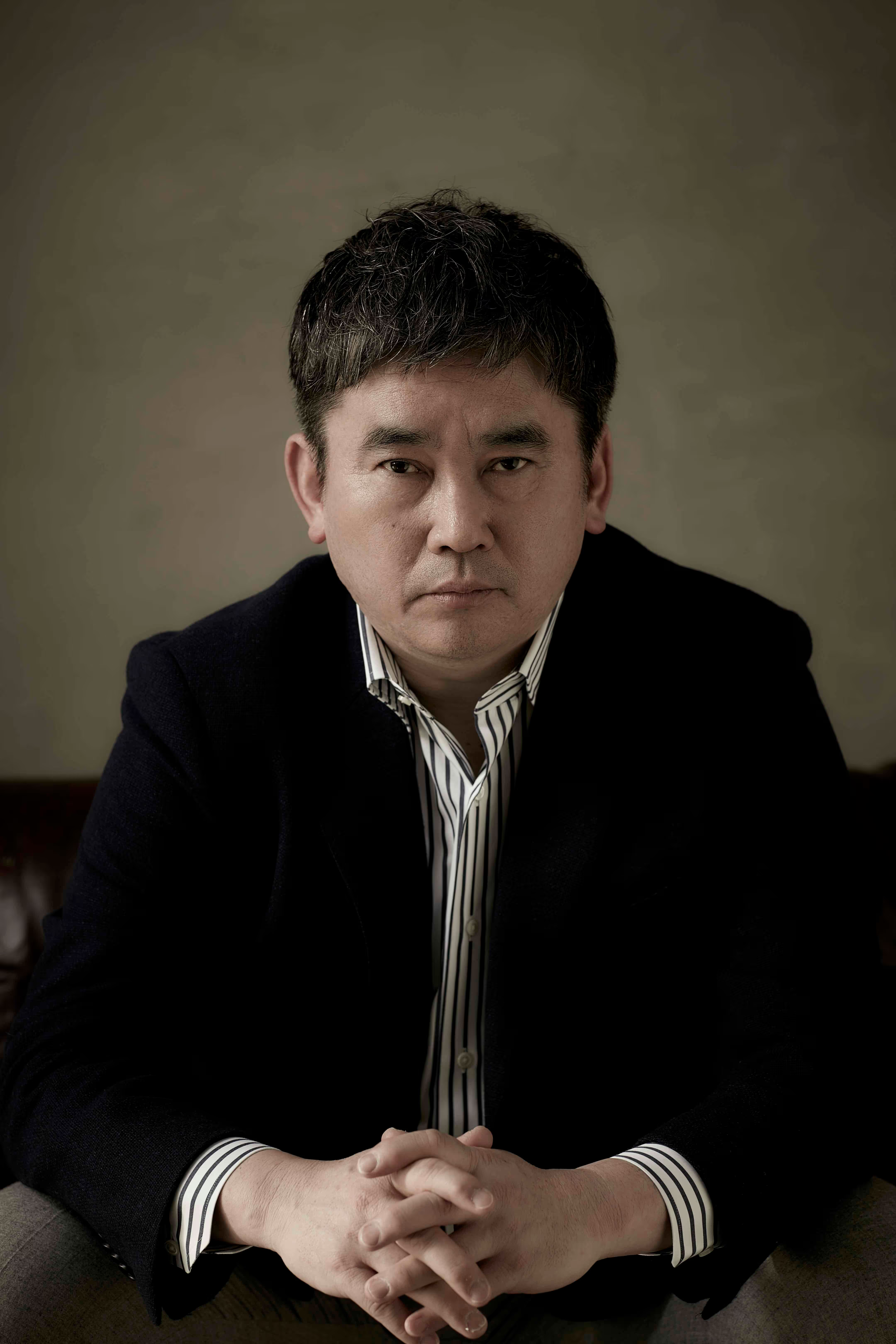
Jin Mayama
Born in Osaka in 1962, Jin Mayama graduated from Doshisha University with a degree in political science before working as a newspaper journalist and freelance writer. He made his literary debut in 2004 with Hagetaka (adapted for film as The Vulture), launching his career as a writer of hard-hitting social fiction grounded in meticulous on-the-ground reporting. His novels tackle the frontlines of contemporary society — from corporate takeovers and nuclear power to space exploration — and many have been adapted for television by NHK and TV Asahi, as well as for film.
Long drawn to the cutting edge of science and technology, Mayama has maintained a close relationship over many years with Akira Furukawa, a world-leading researcher in optical quantum computing and Director of OptQC. In 2023, he published Shippai suru Jiyū ga Chōetsu wo Umu (Shogakukan Shinsho), a richly detailed work based on in-depth interviews with Furukawa.